

Who this is for
This is for the physician or medical professional who owns a plastic surgery or aesthetic medicine practice with self-pay cosmetic patients. Dermatology practices, cosmetic dentistry, and med spas included. It is also for the operations lead, the person who writes consultation scripts, plans service bundles, and sets the marketing budget.
What we found
The Washington, DC-based American Academy of Facial Plastic and Reconstructive Surgery (AAFPRS) surveys its members each year. In its 2025 survey, 45% of the facial plastic surgeons it surveyed said more female patients cited menopause or perimenopause as a reason for treatment. That share was 28% in 2024.1
When asked which specific treatments appealed, women most often named injectables. Galderma, the Swiss maker of Restylane, Sculptra, and Dysport, conducted the survey. In it, 47% of women would consider anti-wrinkle treatment for menopause-related skin changes, and 41% would consider hyaluronic acid (HA) treatment.2
many women remain unaware of the skin-related impacts of menopause.
How many US women are in the menopause transition?
About 41 million US women were aged 45 to 64 in 2020, the ages when vasomotor symptoms (hot flashes and night sweats) are most common. The US Food and Drug Administration (FDA) cited that Census Bureau count in a 2025 statement. It put the average age of menopause in the US at 51.3 While individual experiences can vary widely, the US Office on Women's Health puts the average at 52, so 51 to 52 is a fair range. It defines perimenopause as "the time before menopause when your hormone levels change," which lasts about four years on average and up to 10.4
The National Institute on Aging (NIA), part of the National Institutes of Health, says more than 1 million women reach menopause each year. The transition usually starts between ages 45 and 55 and lasts about seven years.5
Most women in their late 40s and early 50s report symptoms. In a 2026 Gallup report on women's health, 74% of women aged 45 to 54 said they had current or past symptoms of perimenopause or menopause, by their own account.6
How fast is menopause attention growing, and how many women discuss it with a provider?
Traffic to menopause telehealth sites rose sharply from 2023 to 2026. Similarweb, a web traffic analytics company, conducted an analysis for WIRED, the technology magazine. Four leading perimenopause telehealth startups (Midi, Winona, Alloy, and Evernow) saw a 490% rise in web traffic from 2023 to 2026. Similarweb's analysis concludes there has been an "organic demand surge."7
A second survey by the same polling firm reached 3,845 US women online in July 2026. Just 44% had ever discussed menopause with a healthcare provider. That share was 5% for ages 18 to 34, 27% for ages 35 to 44, 63% for ages 45 to 54, and 73% for ages 55 to 64. Still, 37% first learned about menopause only once they had symptoms themselves.8
KFF, a health policy research nonprofit, conducted a nationally representative survey of 5,055 US women between 18 and 64 in 2024. Among respondents from 50 to 64, 47% said a provider had spoken to them about what to expect in menopause.9
Figure 1. Only 5% of women aged 18 to 34 had ever discussed menopause with a provider, compared with 73% of women aged 55 to 64
AARP's 2025 survey of 4,436 adult women found that 32% lacked important information about menopause.10
We suspect this wider attention may be one reason more patients now name menopause in aesthetic consults, as AAFPRS members reported, though causation isn't proven.
Do women treat menopause skin changes after they appear, or try to prevent them?
In Galderma's survey, more women treated menopause skin changes after they appeared than tried to prevent them. Of those surveyed, 49% currently use aesthetic treatments to treat menopause-related skin changes, compared to 26% who use them for prevention. Galderma suggests a reason: many learned about the effect on their skin only while going through menopause. Over 30% would have liked to learn about it in their 30s.2
Galderma's October 2026 release names what it calls "the menopausal skin misread." In the survey the release reports, 56% of respondents first put skin changes from menopause down to aging. Fewer than a third (29%) recognized menopause as the cause. Still, 82% agreed that understanding the difference better would help them feel more informed and in control of their skincare decisions.11
A 2025 review in the Journal of Cosmetic Dermatology, a Wiley journal, reached a similar view. It says "many women remain unaware of the skin-related impacts of menopause." It adds that "few aesthetics studies analyze data based on menopausal status or HRT use."12 HRT is hormone replacement therapy.
Figure 2. Estrogen, collagen and elasticity decline across the menopause transition, with a sharper drop at menopause
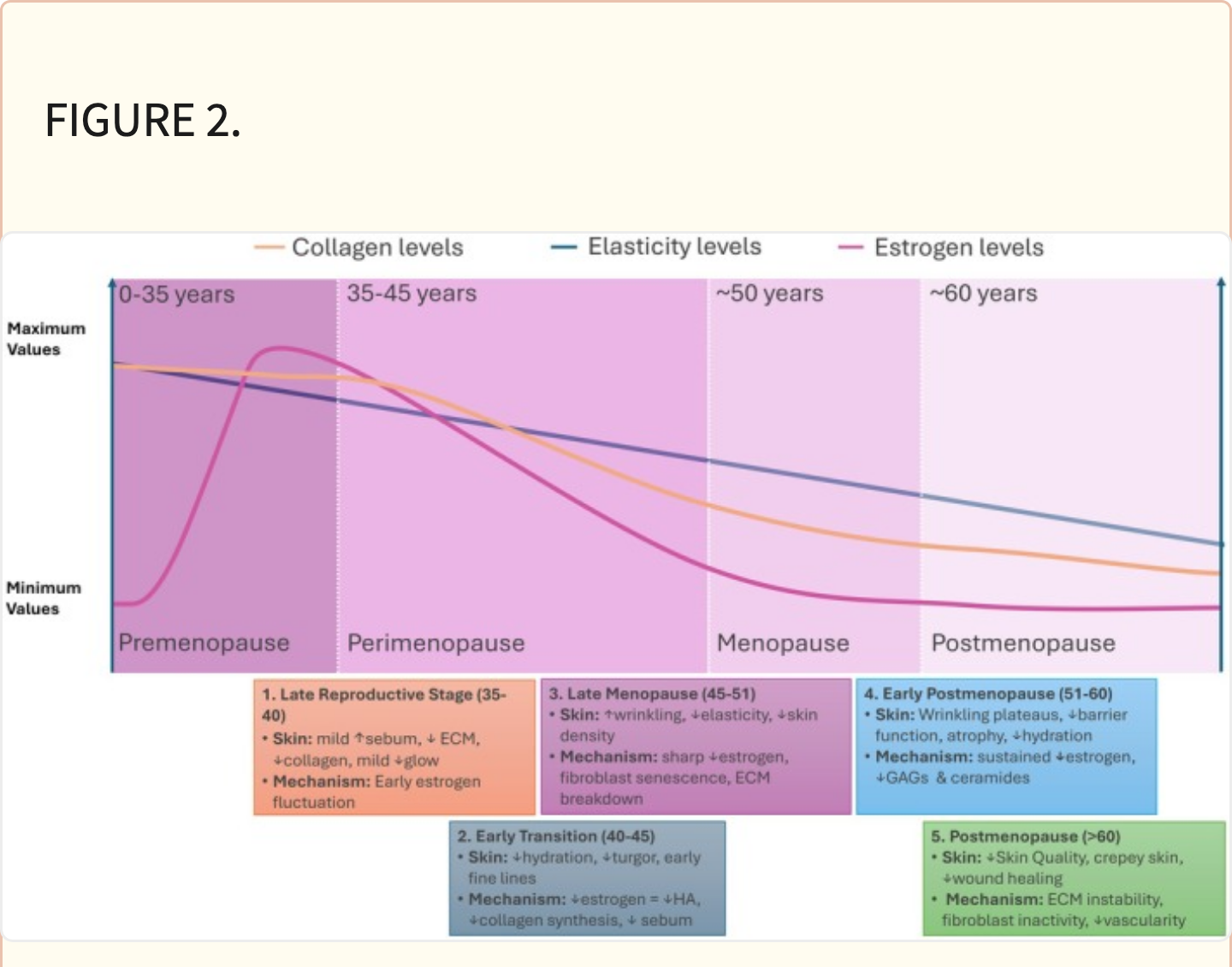
Illustrative trajectory of skin quality changes across menopause. A conceptual overview of skin quality changes across menopausal stages. Trajectories of collagen and elasticity are shown alongside other skin quality changes and proposed mechanistic drivers at each stage. Estrogen levels are depicted as peaking in the late 20s and declining gradually before menopause, with a sharper drop at the menopausal transition. Collagen and elasticity generally follow similar patterns. These trends represent average trajectories and may vary widely across individuals. ↑, increase; ↓, decrease; ECM, extracellular matrix; GAGs, glycosaminoglycans; HA, hyaluronic acid.
Galderma also reports an injectable study in patients with skin changes from menopause. One group received Restylane Skinboosters, an HA injectable for skin quality, before Sculptra, a collagen-stimulating injectable. That group saw facial dermal thickness, the thickness of the skin layer beneath the surface, rise 27.3%. The group treated in the reverse order saw a 15.7% rise. Across the study, 98% reported natural-looking results.11
Dr. Andreas Nikolis, a board-certified plastic surgeon in Montreal, called the study "a new evidence-based framework for treating menopausal skin."11 Galderma presents the two-product sequence as a protocol for menopausal skin. On our reading, it is possible Galderma's sales teams will pitch it to practices as a bundle specifically for menopausal skin treatment. For more about HA filler and biostimulator spending, see injectable spending trends.
Figure 3. 82% of women said telling menopause skin changes from aging would help them, but only 29% recognized menopause as the cause
What did the FDA change for menopausal hormone therapy in 2025, and what are telehealth companies claiming?
Aesthetic practices may hear more of these questions as hormone therapy draws more attention. On November 10, 2025, the US Food and Drug Administration (FDA) asked makers of menopausal hormone therapy (MHT) to change their labeling to clarify its benefits and risks. MHT is also referred to as hormone replacement therapy (HRT).3 In the same years, telehealth startups have marketed it heavily online, as 6.3 describes.7
The FDA also said MHT "may be under-utilized," citing its own review of US outpatient prescriptions for systemic estrogen in 2020.3
WIRED reports that Midi, one of the four telehealth startups, relies "heavily on creating buzzy digital marketing content." One Midi claim, that 91% of patients "find relief within 2 months," drew a challenge from BBB National Programs' National Advertising Division, which monitors truth in advertising. Midi subsequently stopped using the claim.7
The 2025 Journal of Cosmetic Dermatology review says clinical guidelines do not support HRT "solely for estrogen-deficient skin," because skin-specific clinical trials are lacking.12 On our reading, a practice that considers marketing hormone therapy alongside skin treatment would weigh that limitation first.
Where do midlife women get menopause information, and how do they judge providers?
About half get information from professionals, and many had to push to be heard. In the July 2026 survey of 3,845 women, 51% of respondents had gotten menopause information from doctors or other medical professionals. Just 25% felt they had a good understanding of menopause treatment options.8 For more about how patients pick a provider, see how patients choose.
Gallup's 2026 report on women's health asked about seeking treatment for perimenopause or menopause symptoms. Of those respondents, 24% had to push to be taken seriously or to receive treatment. Another 23% saw multiple providers before their symptoms were addressed or diagnosed. Finally, 20% could not get the care they needed despite trying.6
KFF's 2022 poll of 5,145 US women between 18 and 64 asked about provider visits in the past two years. Among those who had seen a provider in that time, 29% said their doctor had dismissed their concerns.13
Figure 4. 24% of women seeking menopause care had to push to be taken seriously, and 20% could not get the care they needed
What we would do
We would add menopausal status and current hormone therapy use to your intake form, then compare rebooking and satisfaction across those groups after six months. The 2025 Wiley review says few aesthetic studies record this, so your own records may be the best source of information about which treatment plans suit your patient population in the short term.
Before accepting a two-product menopause bundle from a sales rep, we would trial the sequence on a select number of patients and log cost per patient, visits, rebooking, and of course satisfaction and safety. This will show whether the manufacturer's study result holds in your practice before you commit stock or set a price.
AAFPRS advises women to raise menopause symptoms with their own health providers, so we would keep a short list of local menopause-informed physicians, log each referral and whether that patient returns, compared with patients who were not referred. That tells you whether referring keeps or loses the patient.
Before hiring a prescriber to offer hormone therapy, we would ask the practice's lawyer or a state-law expert who may prescribe and supervise it in your state. We would also ask what support your ads need for any menopause claim.
AAFPRS also says a consultation should start by listening to the patient's goals, so we would book menopause-related consults in a longer slot to start. We would then compare treatments booked per consult hour against standard consults to decide whether the longer slot is effective and how it may impact schedule and staff availability.
few aesthetics studies analyze data based on menopausal status or HRT use.
About this review
We read 13 sources in November 2026. They were one FDA page, one NIA page, one peer-reviewed review, two academy releases, two Gallup reports, two KFF surveys, one AARP report, two Galderma releases, and one WIRED article. Each data point is named for its publisher. None is combined with another publisher's.
The Gallup survey covers US women polled online in 2026, and the KFF surveys cover US women from 18 to 64 in 2022 and 2024. The AARP survey covers adult women in 2025. The academy surveys cover its member surgeons in 2024 and 2025. The Galderma releases describe the company's own surveys and an injectable study, published in 2026. The FDA and NIA pages date from 2025. The WIRED article reports a Similarweb analysis of web traffic from 2023 to 2026.
Fractional Aesthetics is a growth strategy practice for aesthetic medical businesses.
Notice
This article is for informational purposes only. It describes published sources and gives our opinion on what they mean for running a practice. It is not medical or legal advice, it does not create a doctor‑patient or attorney‑client relationship, and it should not be used to make any medical or legal decision. Discuss treatment with a qualified healthcare provider and legal questions with a licensed attorney. What it says about any company, product or pharmacy comes from the sources cited below, and anything beyond them is our opinion. To report an error, email lazar@fractionalaesthetics.com and we will review it.
How patients see your practice
The FAx audit scores what a prospective patient sees: search, reviews, presence and AI. It takes two minutes to request and needs no call, and the audit arrives by email within a couple of business days, yours to keep.
More market research
Liposuction led US cosmetic surgery in 2025... Can a PA run the first consult?Liposuction was the top US cosmetic surgery in 2025, at 317,196 procedures.7 min read Price tops how patients pick a cosmetic provider. Does posting prices help?Price led a 2023 consumer survey of what decides a cosmetic provider, at 33%.7 min read Most providers offer their own payment plans. What do those plans cost?Healthcare finance staff report defaults above 20% on in-house plans over 12 months.7 min readReferences (13)
- American Academy of Facial Plastic and Reconstructive Surgery, Menopause and facial aging press release, 2026. Industry survey. https://www.aafprs.org/Media/Press_Releases/Menopause_and_Facial_Aging.aspx Back to where you were ↑
- Galderma, Galderma tackles menopause-related skin changes, 2026. Manufacturer-published. https://www.galderma.com/news/galderma-tackles-menopause-related-skin-changes Back to where you were ↑
- U.S. Food and Drug Administration, FDA requests labeling changes related to safety information to clarify benefit/risk considerations for menopausal hormone therapies, 2025. Regulator. https://www.fda.gov/drugs/drug-alerts-and-statements/fda-requests-labeling-changes-related-safety-information-clarify-benefitrisk-considerations Back to where you were ↑
- US Department of Health and Human Services, Office on Women's Health, Menopause basics, 2026. Government. https://www.womenshealth.gov/menopause/menopause-basics Back to where you were ↑
- NIH National Institute on Aging, Research explores impact of menopause on women's health and aging, 2025. Government. https://www.nia.nih.gov/news/research-explores-impact-menopause-womens-health-and-aging Back to where you were ↑
- Gallup, Women's healthcare barriers extend to work, family life, 2026. Industry survey. https://news.gallup.com/poll/714221/women-healthcare-barriers-extend-work-family-life.aspx Back to where you were ↑
- WIRED, Inside the perimenopause industrial complex, 2026. Trade press. https://www.wired.com/story/inside-the-perimenopause-industrial-complex/ Back to where you were ↑
- Gallup, Many women enter menopause without clear information, 2026. Industry survey. https://news.gallup.com/poll/714596/women-enter-menopause-without-clear-information.aspx Back to where you were ↑
- KFF, Women's experiences with preventive and health care services: findings from the 2024 KFF Women's Health Survey, 2025. Industry survey. https://www.kff.org/womens-health-policy/womens-experiences-with-preventive-and-health-care-services-findings-from-the-2024-kff-womens-health-survey/ Back to where you were ↑
- AARP, Menopause knowledge gaps report, 2025. Industry survey. https://www.aarp.org/health/conditions-treatments/menopause-knowledge-gaps-report/ Back to where you were ↑
- Galderma, The menopausal skin misread, 2026. Manufacturer-published. https://www.galderma.com/news/the-menopausal-skin-misread Back to where you were ↑
- Journal of Cosmetic Dermatology (Wiley), review of estrogen decline, menopause, and skin, 2025. Peer-reviewed. https://pubmed.ncbi.nlm.nih.gov/40847905/ Back to where you were ↑
- KFF, Women's experiences with provider communication and interactions in health care settings: findings from the 2022 KFF Women's Health Survey, 2023. Industry survey. https://www.kff.org/womens-health-policy/womens-experiences-with-provider-communication-interactions-health-care-settings-findings-from-2022-kff-womens-health-survey/ Back to where you were ↑