

Who this is for
This is for the physician or medical professional who owns a plastic surgery or aesthetic medicine practice with self-pay cosmetic patients, including a dermatology practice, cosmetic dental practice, or med spa that offers neurotoxins and fillers. Practices in the US, UK, UAE, and beyond are included. It is also for the operations lead who orders injectable stock, sets injectable prices, and plans the marketing budget.
What we found
In the US counts and spending data we read, neurotoxins lead fillers in popularity. Today filler is also sold alongside a smaller share of toxin treatments than it was in 2017. AbbVie makes Botox Cosmetic and Juvéderm through its Allergan aesthetics business. AbbVie reported $669 million in global net revenue for Botox Cosmetic in the quarter ended September 30, 2026, and $222 million for Juvéderm. Net revenue is what AbbVie took in from selling these products worldwide after discounts, allowances, etc.1 Inside MedSpa, a trade publication covering med spas, reported Botox Cosmetic up 4.1% and Juvéderm down 11.8% from a year earlier. Both changes were on an operational basis, which removes the effect of exchange rates on the sales AbbVie makes in other currencies.2
Guidepoint Qsight is a market data company tracking patient purchases at US aesthetic practices. Qsight's dollar totals reflect what patients paid at checkout in the practices it follows. It recorded neurotoxins at 32% of US non-surgical aesthetic spending in 2024. Dermal fillers took 20% of spending.3
How many neurotoxin and filler treatments did US patients get in 2024?
The American Society of Plastic Surgeons (ASPS) counted 9,883,711 (9.9M) neuromodulator injection procedures in the US in 2024. It also counted 5,331,426 (5.3M) hyaluronic acid (HA) filler procedures.4 Botox is a neuromodulator and Juvéderm an HA filler, so these counts include both brands.
Neuromodulators ranked first among minimally invasive procedures that year, and HA fillers ranked second. The society reports neuromodulator and HA filler counts up 4% and 1% respectively from 2023.4
Botulinum toxin and hyaluronic acid also ranked first and second among nonsurgical procedures worldwide in 2024. The International Society of Aesthetic Plastic Surgery (ISAPS) counted 7,887,955 (7.9M) botulinum toxin procedures and 6,338,184 (6.3M) hyaluronic acid procedures that year.5 Note that these numbers are global as compared with the US-only numbers above.
The data comes from more than 25,000 US cash-pay med spas and physician aesthetic practices. In that data, US patient spending on neurotoxins rose 8% from 2023 to 2024.6 Per-unit toxin pricing is the subject of what patients pay for Botox.
What did AbbVie and Evolus report for toxin and filler sales in Q3 2026?
AbbVie's aesthetics sales slipped. Botox Cosmetic grew, while Juvéderm shrank, in that quarter. AbbVie reported $1.18 billion in global net revenue from its aesthetics portfolio for the period.1
Inside MedSpa put the portfolio's decline at 1.8% on an operational basis. The publication wrote that this decline "masks divergent results within the portfolio."2
We suspect Juvéderm's drop could reflect fewer filler treatments, a move to other filler brands, or practices holding less stock, though causation isn't proven.
Evolus, another company that sells aesthetic injectables, grew in the same quarter. Evolus reported $78.0 million in revenue for that period, up 13% year over year.7
How often is filler sold alongside neurotoxin treatments?
Today filler is sold alongside neurotoxin less often than it was in 2017. In Guidepoint Qsight's sales data, the share of US neurotoxin treatments sold alongside a dermal filler treatment peaked at around 21% in 2017. It had fallen to 13% by 2025, and Qsight recorded no change (13%) for the first quarter of 2026.8
Qsight writes that the decline "for most aesthetics brands went completely undetected." Brands had judged what patients buy together from sales reps' observations, practitioner reports, and industry assumptions, which, Qsight writes, could not scale or update in real time. It describes the toxin and filler pairing as one that brands had "long treated as set in stone."8
Figure 1. The share of US neurotoxin treatments sold with a dermal filler fell from around 21% in 2017 to 13% by 2025
- 2017Peak at around 21%
- 2025Down to 13%
- Q1 2026Holds at 13%
Is falling hyaluronic acid filler spending moving to other fillers?
In Guidepoint Qsight's data, part of that spending appears to be moving to biostimulators. Biostimulatory injectables prompt the body to build its own collagen. Qsight recorded US patient spending on HA fillers dropping from $3.2 billion in 2023 to $2.7 billion in 2025, a 15.6% fall. Spending on biostimulatory injectables rose 9.2% over those two years, to $830 million from $760 million.9
Qsight writes that biostimulatory fillers "appear to be gaining the share that traditional HA fillers are losing."9
Spending by filler type from 2023 to 2025 is broken out further in injectable spending trends.
Figure 2. US patient spending on HA fillers fell 15.6% to $2.7 billion from 2023 to 2025, while biostimulatory injectables rose 9.2% to $830 million
What injectable mix do individual practices and patients report?
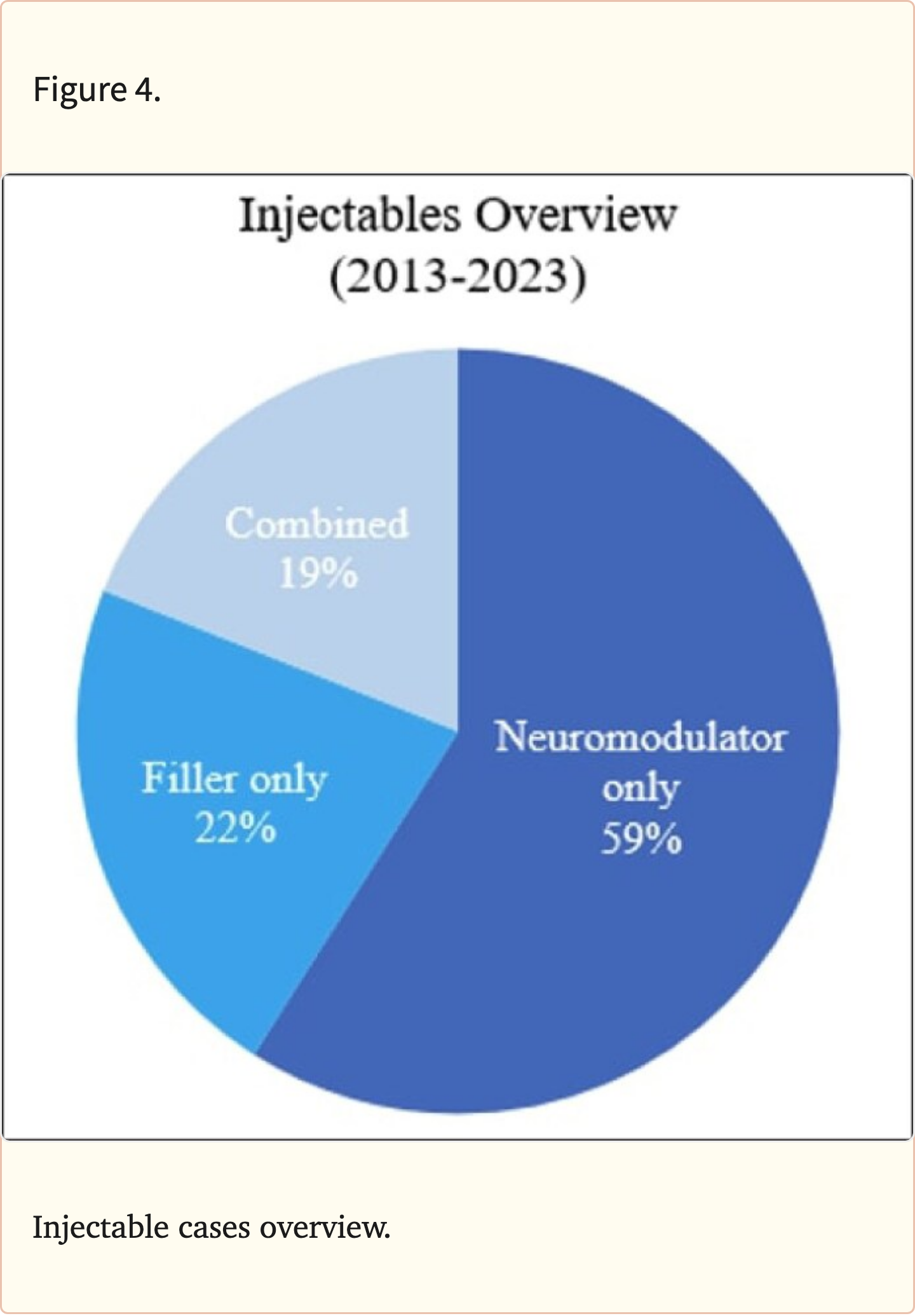
In one academic practice's records, neurotoxin made up the largest share of injectable cases. A 2025 study in Aesthetic Surgery Journal Open Forum, the open-access journal of The Aesthetic Society, reviewed 5,794 injectable cases in 1,368 patients. The study's senior author performed all of them between January 2013 and January 2023.10
Of the cases the study sorted by type, botulinum toxin alone made up 59%, filler alone 22%, and the two combined 19%. Case counts rose over the decade, apart from a dip in 2020.10
Common toxin sites were the glabella (the frown lines between the brows), crow's feet, and forehead. Common filler sites were marionette lines and nasolabial folds.10
Figure 3. Botulinum toxin alone made up 59% of injectable cases at one academic practice from 2013 to 2023, filler alone 22%, and the two combined 19%
In a separate consumer study, more women reported neurotoxin injections than fillers. GCI Magazine, a cosmetics industry trade magazine, reported a May 2026 online study by The Benchmarking Company, a beauty market research firm. The study polled more than 4,000 US female beauty buyers. Among procedures the women said they had in the past five years, neurotoxin injections stood at 9%. Fillers such as Restylane or Juvéderm stood at 4%.11
What we would do
We would split the past year's injectable visits into toxin only, filler only, and both, quarter by quarter. That quarterly trend should set next year's hyaluronic acid syringe order.
Guidepoint Qsight says a standard script at the toxin visit helps sell filler. We would have every injector use a specific filler mention for a quarter, and track in the practice's own booking records how many toxin visits that quarter also include filler. If that count does not move, we would test moving the filler conversation to a separate consult.
Qsight writes that biostimulators appear to be gaining the share hyaluronic acid fillers are losing.9 So we would log biostimulator and hyaluronic acid syringes separately each month. Count them apart. That record tells us how to split the filler purchasing budget.
Qsight also suggests keeping more than one neurotoxin brand on hand. Before signing any exclusive volume deal with one manufacturer, we would record which toxin brand each patient receives and whether that patient rebooks to determine if brand impacts your sales. From there, you can dig in further to determine what specifically might be causing the effect.
The academic study's authors note that patients may move between injectables and surgery. We would flag on each injectable chart any surgical interest a patient raises, to decide whether follow-up visits should include a surgeon consult slot, if applicable.
About this review
We read 11 sources in November 2026: two company earnings releases (AbbVie and Evolus), two trade press reports (Inside MedSpa and GCI Magazine), two society surveys (ASPS and ISAPS), one peer-reviewed study, and four Guidepoint Qsight publications. Each data point is credited to the company or society that published it.
The AbbVie and Evolus releases cover company sales for the quarter ended September 30, 2026. AbbVie's numbers are worldwide. Qsight's data covers transactions at US cash-pay med spas and physician practices from 2017 to the first quarter of 2026. The ASPS counts cover US procedures in 2024. The ISAPS survey covers procedures member plastic surgeons reported worldwide in 2024. The 2025 study covers one academic surgeon's injectable cases from 2013 to 2023. The consumer study covers US female beauty buyers in May 2026.
Fractional Aesthetics is a growth strategy practice for aesthetic medical businesses.
Notice
This article is for informational purposes only. It describes published sources and gives our opinion on what they mean for running a practice. It is not medical or legal advice, it does not create a doctor‑patient or attorney‑client relationship, and it should not be used to make any medical or legal decision. Discuss treatment with a qualified healthcare provider and legal questions with a licensed attorney. What it says about any company, product, or pharmacy comes from the sources cited below, and anything beyond them is our opinion. To report an error, email lazar@fractionalaesthetics.com and we will review it.
How patients see your practice
The FAx audit scores what a prospective patient sees: search, reviews, presence and AI. It takes two minutes to request and needs no call, and the audit arrives by email within a couple of business days, yours to keep.
More market research
Citerra Finance offers patient loans up to $50,000. What are its terms?Citerra Finance lists patient loans of $1,000 to $50,000 at rates of 0.0% to 23.99%.6 min read More women cite menopause in aesthetic consults: what's it mean?In 2025, 45% of facial plastic surgeons said more women cited menopause, up from 28%.7 min read Liposuction led US cosmetic surgery in 2025... Can a PA run the first consult?Liposuction was the top US cosmetic surgery in 2025, at 317,196 procedures.7 min readReferences (11)
- AbbVie, AbbVie reports third-quarter 2026 financial results, 2026. Manufacturer-published. https://investors.abbvie.com/news-releases/news-release-details/abbvie-reports-third-quarter-2026-financial-results Back to where you were ↑
- Inside MedSpa, AbbVie's aesthetics revenue slips as Botox Cosmetic gains, 2026. Trade press. https://insidemedspa.com/article/abbvie-aesthetics-revenue-slips-botox-cosmetic-gains/ Back to where you were ↑
- Guidepoint Qsight, 2024 aesthetics industry overview presentation, 2025. Vendor-published. https://qsight.guidepoint.com/wp-content/uploads/2025/01/Qsight-Presentation-Octane-January-2025.pdf Back to where you were ↑
- American Society of Plastic Surgeons, Interest in aesthetic health remained consistent despite economic uncertainty in 2024, 2025. Industry survey. https://www.plasticsurgery.org/news/press-releases/interest-in-aesthetic-health-remained-consistent-despite-economic-uncertainty-in-2024-according-to-new-report-from-american-society-of-plastic-surgeons Back to where you were ↑
- International Society of Aesthetic Plastic Surgery, ISAPS Global Survey 2024, 2025. Industry survey. https://www.isaps.org/media/oogpzodr/isaps-global-survey_2024.pdf Back to where you were ↑
- Guidepoint Qsight, Generational neurotoxin use across the United States, 2025. Vendor-published. https://qsight.guidepoint.com/wp-content/uploads/2025/12/Qsight-Neurotoxin-Report_12-11-25.pdf Back to where you were ↑
- Evolus (Business Wire), Evolus reports third quarter 2026 financial results with 13% year-over-year revenue growth, 2026. Manufacturer-published. https://www.businesswire.com/news/home/20261104665183/en/Evolus-Reports-Third-Quarter-2026-Financial-Results-with-13-Year-Over-Year-Revenue-Growth-Delivers-Fourth-Consecutive-Quarter-of-Positive-Adjusted-EBITDA-and-Reaffirms-Full-Year-2026-Financial-Outlook Back to where you were ↑
- Guidepoint Qsight, Cross-purchasing analytics for medical aesthetics, 2026. Vendor-published. https://qsight.guidepoint.com/blog/cross-purchasing-analytics-for-medical-aesthetics/ Back to where you were ↑
- Guidepoint Qsight, Gen Z: the preventive aesthetics era, a generational shift in consumer behavior, 2026. Vendor-published. https://qsight.guidepoint.com/blog/gen-z-the-preventive-aesthetics-era-a-generational-shift-in-consumer-behavior/ Back to where you were ↑
- Aesthetic Surgery Journal Open Forum, review of botulinum toxin and soft-tissue filler cases at an academic practice, 2013 to 2023, 2025. Peer-reviewed. https://pubmed.ncbi.nlm.nih.gov/40589659/ Back to where you were ↑
- GCI Magazine, The procedure-to-product pipeline is growing: new consumer survey data, 2026. Trade press. https://www.gcimagazine.com/brands-products/skin-care/article/22967909/the-proceduretoproduct-pipeline-is-growing-new-consumer-survey-data Back to where you were ↑