

Who this is for
This is for the physician or medical professional who owns a plastic surgery or aesthetic medicine practice in the US, UK, UAE and beyond, where self-pay patients ask about body contouring surgery. Dermatology practices, cosmetic dental practices and med spas that perform this surgery or refer patients for it are included. It is also for the operations lead who decides which clinician sees each new patient first, books return visits and sets the marketing budget.
What we found
The American Society of Plastic Surgeons (ASPS) described a study in a 2026 press release. In that study, an advanced practice provider (APP), meaning a physician assistant or nurse practitioner, ran the first body contouring visit. About half of patients were ready for surgery, meaning they could go on to see the surgeon. The rest were told to return in three to six months.1
The guidelines one 2018 study followed asked abdominoplasty patients for at least 6 weeks smoke-free and at least 6 months of stable weight.2 Strkr, a software company, gives an example follow-up cadence that runs to 14 days.3 On our reading, a follow-up sequence that short ends well before a patient told to wait three to six months could return.
“Here are your things to work on. Come back in three to six months.”
How many tummy tucks did US surgeons perform in 2025, and how often did GLP-1 patients ask about body contouring?
Tummy tuck volume rose slightly in 2025. The society counted 173,251 tummy tuck (abdominoplasty) procedures in the US that year, up 2% from 2024. It was one of the five most common US cosmetic surgeries that year.4
Weight-loss drugs are a common reason for these consultations. In the society's 2025 member survey, 82% of member surgeons reported consultation requests related to GLP-1 medications. GLP-1 drugs are the weight-loss class that includes semaglutide and tirzepatide. Asked which body procedures drew those consultations, 88% of surgeons named tummy tuck, 67% panniculectomy, and 62% body lift. A panniculectomy removes hanging abdominal skin.5
On our reading, a patient still losing weight on a GLP-1 drug may not yet meet a stable-weight requirement at a first visit. For more on how these patients are changing practice menus, see our GLP‑1 menu review.
What did an APP-led first visit decide for body contouring patients?
The APP-led first visit ended with one of two answers: the patient was ready to meet the surgeon, or the patient had steps to finish first. The society's release on the study gives both messages. One reads "Here are your things to work on. Come back in three to six months." The other reads "Let's get you set up with the surgeon."1
A society article written for patients says seeing a PA or an NP first may help them reach body contouring surgery.6
Plastic Surgery Practice, a trade publication for plastic surgery practices, covered the study in 2026. Its headline read "Starting body contouring consults with an APP boosts surgical conversion rates."7
On our reading, the APP visit moves the readiness check ahead of the surgeon's consult, which may be mutually beneficial for both patient and practice. For more about who may run that first visit, see PA‑led first consults.
How long do guidelines ask body contouring patients to stop nicotine and hold a stable weight?
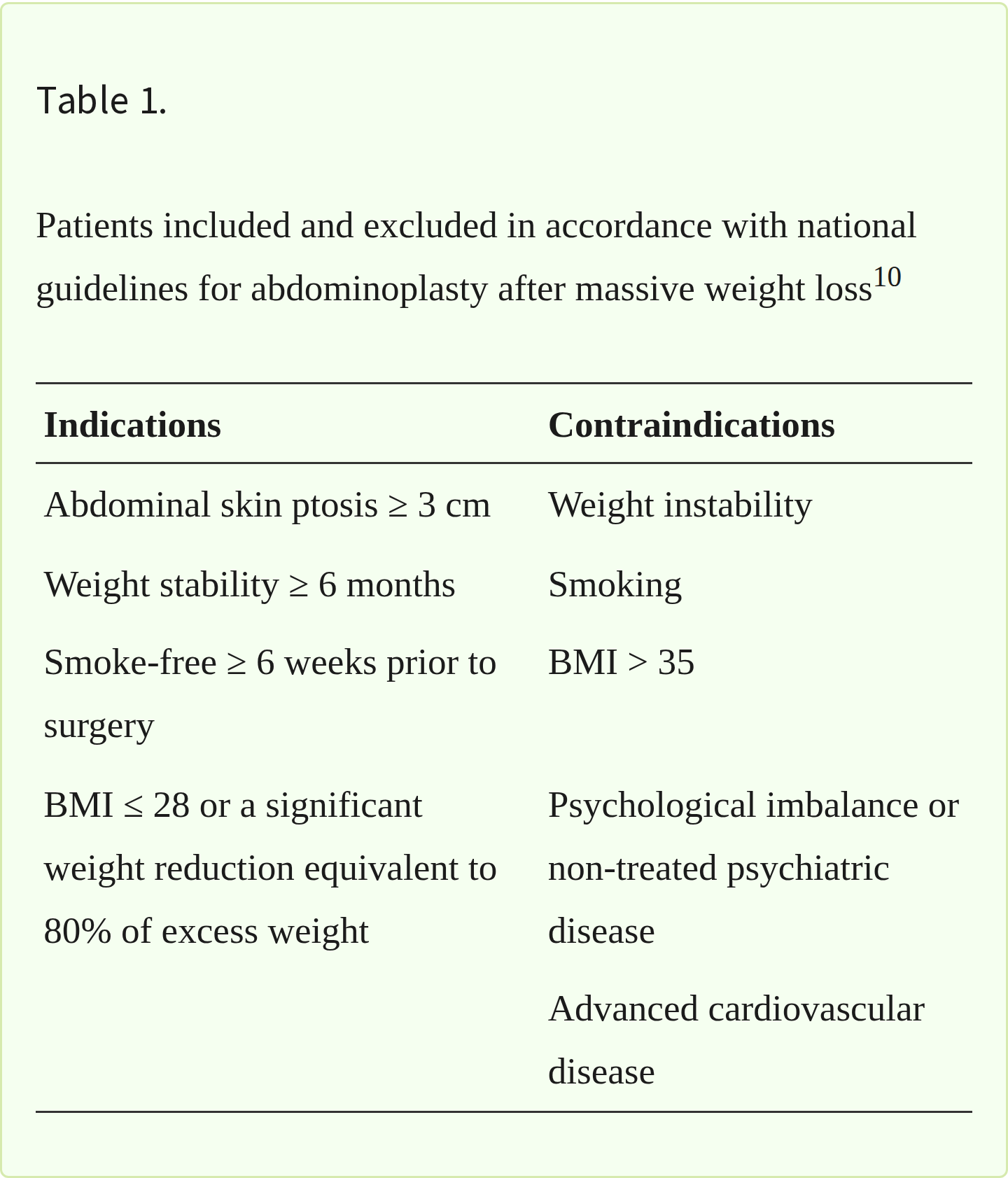
Patients needed weeks without smoking and months at a stable weight. The 2018 study, in Plastic and Reconstructive Surgery Global Open, applied national guidelines for abdominoplasty after massive weight loss. Beyond the smoke-free and stable-weight periods, those guidelines asked for a BMI (body mass index) of 28 or less, or a weight loss equal to 80% of the patient's excess weight.2
Table 1. Guidelines for abdominoplasty after massive weight loss asked for at least 6 weeks smoke-free, at least 6 months of stable weight and a BMI of 28 or less or a loss of 80% of excess weight
Government guidance also addresses nicotine before surgery. The Office of the Surgeon General's 2020 report on quitting smoking was published by the Centers for Disease Control and Prevention (CDC). It says cessation programs that begin 4 to 8 weeks before surgery reduce complications after surgery. Those programs include weekly counseling and nicotine replacement therapy (NRT).8
The CDC's guidance for clinicians says counseling and medication used together "can more than double the chances of quitting."9 A practice that tells a patient to quit can offer both itself or refer the patient to their own physician.
One study set a much longer nicotine window. A 2021 article in the International Wound Journal, a Wiley journal, says in its abstract that quitting smoking half a year or more before surgery "is mandatory to reduce the risk of complications."10 Under that standard, a smoker's return visit falls far later than under the 6-week one.
How often do complications follow body contouring, and do BMI and smoking raise the rate?
Complications are common after body contouring. A 2026 study in Aesthetic Plastic Surgery, a Springer Nature journal, reported an overall complication rate of 27.3%, counting both minor and major events.11
Seroma was the most frequent complication in that 2026 study, at a rate of 14.6%. A seroma is fluid collecting under the skin. Wound dehiscence (the incision reopening) followed at 6.6%, then partial skin necrosis (patches of skin tissue dying) at 4.6%. A BMI of 30 or higher and active smoking were each independent predictors of complications. That is, each was linked to complications after the authors accounted for the other factors in their analysis.11
Figure 1. Seroma was the most frequent complication after body contouring in a 2026 study, at 14.6%
A 2014 paper in Plastic and Reconstructive Surgery also examined risk factors and complication rates in abdominoplasty.12
Nearly half of body contouring cases after massive weight loss ended in complications, according to a 2023 paper in Aesthetic Plastic Surgery. Its abstract reports an overall complication rate of 49.8%, including 26.8% minor complications. Wounds suffered. Delayed wound healing occurred at a rate of 27.7%, and revision surgery at 25.8%.13
Early complications fell as guidelines improved, per the 2018 Global Open paper. Across its three patient groups, early complications affected 48 patients (70%), then 31 (44%), then 13 (19%). The authors credit improved guidelines and surgical training and experience. Patients in the third group were older and had more other medical conditions.2
Figure 2. Early complications after abdominoplasty fell from 70% of patients to 44% and then 19% across three successive patient groups
How long do vendor follow-up sequences run for patients who have not booked surgery?
Strkr, a software company for medical practices, sends a plan-review follow-up at a cadence the practice sets. Its example is 24 hours, 3 days, 7 days, and 14 days. Silence changes the path. Anyone who goes quiet moves to what Strkr calls a "stalled-plan drip," a series of automated messages set for each service.3
AestheticSuite.ai, a software company for aesthetic practices, says practices that contact patients within 24 hours of a consultation convert more consultations to bookings than those that wait three or more days. It also says structured follow-up over 60 to 90 days beats single follow-up calls "by a wide margin." It puts a solid average for surgical consultation conversion, the share of consultations that book surgery, at 35% to 45%.14
Grow With BA, an agency that advises aesthetic practices on patient acquisition, says the average cosmetic surgery decision takes 4 to 6 months from first inquiry to booking. Its 2026 guide lays out a 14-touch nurture sequence. A touch is one contact such as an email or a text.15
Care Sherpa, a healthcare marketing technology company, wrote a 2023 guide for the Society for Healthcare Strategy & Market Development (SHSMD). Its data show organizations take 72 hours on average to respond to a lead, if they respond at all. A bariatric surgery patient may not have a first appointment until 18 to 24 months after first engaging, it says. One client added post-appointment follow-up messages and saw what the guide reports as a "13% increase in conversions" in under two months.16
Tummy tuck consultations converted to procedures at a median of 41.4% in a 2018 benchmark. Allergan, a maker of aesthetic injectables and devices, and BSM Consulting published it. The sample was large. It drew on more than 25,000 consultations at 220 practices.17
What we would do
For each patient sent home after the initial consult, we would log which step held them back: nicotine, weight stability or BMI, and whether they take a GLP-1. After a quarter, we would read that log to see which step held back the most of our own patients, and where added support might help.
We would ask each not-ready patient, before they leave, to name the goal on their list and how they want to hear from us. The ASPS patient article credits the list with giving patients a goal, and Care Sherpa advises using the channel each patient prefers.
We would set an automated recall in the CRM tied to each patient's return date, so no staff member has to remember it. Recall tasks are often more easily automated than other types of tasks.
We would track consult-to-surgery conversion separately for patients the APP found ready and for patients who returned later. AestheticSuite.ai warns that benchmarks mean little until a practice's own definitions are consistent, and this split shows whether returners book.
About this review
We read 17 sources in November 2026. They were four ASPS publications, one trade press report, two CDC documents, five peer-reviewed studies, one manufacturer-published benchmark, and four vendor pages or guides. We read the 2021 International Wound Journal study and the 2023 Aesthetic Plastic Surgery study in their abstracts. Every number appears under the name of the source that published it, with no sum or average taken across publishers.
The ASPS sources cover one clinic's APP-led body contouring visits, US procedure counts for 2025, and a 2025 survey of member surgeons. The CDC documents are the Surgeon General's 2020 report on quitting smoking and the agency's clinical guidance on treating tobacco use. The peer-reviewed studies cover abdominoplasty and body contouring patients. They were published from 2014 to 2026. The Allergan and BSM benchmark dates from 2018. The vendor guides date from 2023 and 2026, and the Strkr page describes its product.
Fractional Aesthetics is a growth strategy practice for aesthetic medical businesses.
Notice
This article is for informational purposes only. It describes published sources and gives our opinion on what they mean for running a practice. It is not medical or legal advice, it does not create a doctor‑patient or attorney‑client relationship, and it should not be used to make any medical or legal decision. Discuss treatment with a qualified healthcare provider and legal questions with a licensed attorney. What it says about any company, product, or pharmacy comes from the sources cited below, and anything beyond them is our opinion. To report an error, email lazar@fractionalaesthetics.com and we will review it.
How patients see your practice
The FAx audit scores what a prospective patient sees: search, reviews, presence, and AI. It takes two minutes to request and needs no call, and the audit arrives by email within a couple of business days, yours to keep.
More market research
Juvéderm sales fell 11.8% year over year. How often do toxin patients add filler?In 2025, 13% of US toxin treatments came with a filler treatment, down from about 21% in 2017.5 min read Citerra Finance offers patient loans up to $50,000. What are its terms?Citerra Finance lists patient loans of $1,000 to $50,000 at rates of 0.0% to 23.99%.6 min read More women cite menopause in aesthetic consults: what's it mean?In 2025, 45% of facial plastic surgeons said more women cited menopause, up from 28%.7 min readReferences (17)
- American Society of Plastic Surgeons, Advanced practice provider clinic improves access to body contouring surgery, 2026. Industry survey. https://www.plasticsurgery.org/news/press-releases/advanced-practice-provider-clinic-improves-access-to-body-contouring-surgery Back to where you were ↑
- Plastic and Reconstructive Surgery Global Open, study of complications in abdominoplasty after massive weight loss under national guidelines, 2018. Peer-reviewed. https://pmc.ncbi.nlm.nih.gov/articles/PMC5934449/ Back to where you were ↑
- Strkr, Strkr for medical practices. Vendor-published. https://strkr.io/for/medical-practices Back to where you were ↑
- American Society of Plastic Surgeons, 2025 plastic surgery by the numbers: what are the trends in plastic surgery and what it means for you, 2026. Industry survey. https://www.plasticsurgery.org/news/articles/2025-plastic-surgery-by-the-numbers-what-are-the-trends-in-plastic-surgery-and-what-it-means-for-you Back to where you were ↑
- American Society of Plastic Surgeons, The GLP-1 effect: from body to face and what happens next, 2026. Industry survey. https://www.plasticsurgery.org/news/articles/the-glp-1-effect-from-body-to-face-and-what-happens-next Back to where you were ↑
- American Society of Plastic Surgeons, Considering body contouring? Seeing a PA or nurse practitioner first may help you get there, 2026. Industry survey. https://www.plasticsurgery.org/news/articles/considering-body-contouring-seeing-a-pa-or-nurse-practitioner-first-may-help-you-get-there Back to where you were ↑
- Plastic Surgery Practice, Starting body contouring consults with an APP boosts surgical conversion rates, study finds, 2026. Trade press. https://plasticsurgerypractice.com/practice-management/patient-relations/starting-body-contouring-consults-app-boosts-surgical-conversion-rates-study-finds/ Back to where you were ↑
- CDC and Office of the Surgeon General, Smoking cessation: a report of the Surgeon General, 2020. Government. https://stacks.cdc.gov/view/cdc/177089/cdc_177089_DS1.pdf Back to where you were ↑
- Centers for Disease Control and Prevention, clinical guidance on treating tobacco use in patient care settings, 2024. Government. https://www.cdc.gov/tobacco/hcp/patient-care-settings/clinical.html/ Back to where you were ↑
- International Wound Journal (Wiley), study of smoking cessation and wound complications before surgery, 2021 (abstract). Peer-reviewed. https://pmc.ncbi.nlm.nih.gov/articles/PMC7949374/pdf/IWJ-16-1545.pdf Back to where you were ↑
- Aesthetic Plastic Surgery (Springer Nature), study of predictors of complications after body contouring surgery, 2026. Peer-reviewed. http://link.springer.com/article/10.1007/s00266-026-05876-2 Back to where you were ↑
- Plastic and Reconstructive Surgery (Lippincott Williams & Wilkins), Abdominoplasty: risk factors, complication rates, 2014. Peer-reviewed. https://journals.lww.com/plasreconsurg/Fulltext/2014/10001/Abdominoplasty__Risk_Factors,_Complication_Rates.141.aspx Back to where you were ↑
- Aesthetic Plastic Surgery (Springer Nature), study of complications in body contouring after massive weight loss, 2023 (abstract). Peer-reviewed. https://link.springer.com/10.1007/s00266-022-03235-5 Back to where you were ↑
- AestheticSuite.ai, Patient consultation conversion rate benchmarks, 2026. Vendor-published. https://aestheticsuite.ai/blog/patient-consultation-conversion-rate-benchmarks-know Back to where you were ↑
- Grow With BA, Cosmetic surgery patient acquisition guide 2026, 2026. Vendor-published. https://growwithba.com/pdfs/cosmetic-surgery-patient-acquisition-guide-2026.pdf Back to where you were ↑
- Care Sherpa for the Society for Healthcare Strategy & Market Development, Perfect your pipeline, 2023. Vendor-published. https://www.shsmd.org/system/files/media/file/2023/11/Perfect%20your%20Pipeline.pdf Back to where you were ↑
- Allergan and BSM Consulting (hosted by Etna Interactive), New aesthetic industry conversion benchmarks: secrets from the top 10%, 2018. Manufacturer-published. https://www.etnainteractive.com/content/uploads/New-Aesthetic-Industry-Conversion-Benchmarks-Secrets-from-the-Top-10.10.10.18-PDF.pdf Back to where you were ↑